

Thinking about buying your first investment property but not sure where to actually begin? We provide the honest, no-fluff answer: sort out your deposit and borrowing capacity, choose a strategy, obtain pre-approval, and then start looking in that order. Most first-timers do it backwards. They fall in love with a place on realestate.com.au first and try to make the numbers stack up afterwards. Nine times out of ten, that’s how you end up with a property that limps along instead of one that actually works for you.
This guide walks through the process the way we’d talk you through it in a first strategy session using real, current 2026 numbers, not recycled stats from a different rate cycle.
Get started in six steps: a short version
- Get honest about your “why” cash flow, long-term growth, or a bit of both. This one decision shapes everything after it.
- Find out what you can actually borrow and what deposit you’re working with most lenders want 10–20% plus costs.
- Pick your strategy before you pick a suburb growth, yield, or a blend of the two.
- Get pre-approved so you’re house-hunting with a real number, not a guess.
- Let the data do the talking vacancy rates, yield, infrastructure spend, what’s being built nearby.
- Buy, settle, and set yourself a review date this is the start of a portfolio, not a one-off purchase.
We’ll go through each of these properly below, with the figures that actually matter right now.
Where the Australian Market Sits in 2026
Before you run any numbers of your own, it’s worth knowing what kind of market you’re stepping into:
| Metric | Current Figure (2026) | Source |
|---|---|---|
| RBA cash rate | 4.35% (held at the August 2026 meeting) | Reserve Bank of Australia |
| National median dwelling value | ~$928,000 | Cotality Home Value Index, August 2026 |
| Combined capital cities median | ~$1.01 million | Cotality |
| National average gross rental yield | ~4.7% | Cotality / Global Property Guide |
| National rental vacancy rate | ~1.7% | Cotality |
Two things worth flagging here. First, the RBA’s held rates through most of 2026 after an earlier run of hikes so borrowing costs are steady, but they’re not cheap, and you should still stress-test your budget against a higher rate, not today’s rate. Second, vacancy is sitting near record lows nationally (1.7%), which explains why yields have held up even with prices where they are there’s genuine rental demand doing the heavy lifting in most areas. Growth has also gone pretty patchy compared to a few years back: some capitals kept climbing through 2026 while Sydney and Melbourne cooled off. The old “just buy anywhere, growth follows” logic doesn’t really hold up in a market like this one.
Step 1: Get Honest About Why You’re Investing
Every property strategy really comes down to one of two questions or some mix of both:
- Do you want cash flow now? A property that mostly pays for itself through rent.
- Do you want wealth later? A property that grows in value, even if it costs you a bit each month to hold.
Neither answer is “more correct” than the other it comes down to your income, your timeframe, and how much of a monthly shortfall you can comfortably wear. What matters is working this out before you start scrolling listings, because it decides which suburbs, property types and price points are even worth your time.
Step 2: Get Real About the Deposit and the Borrowing
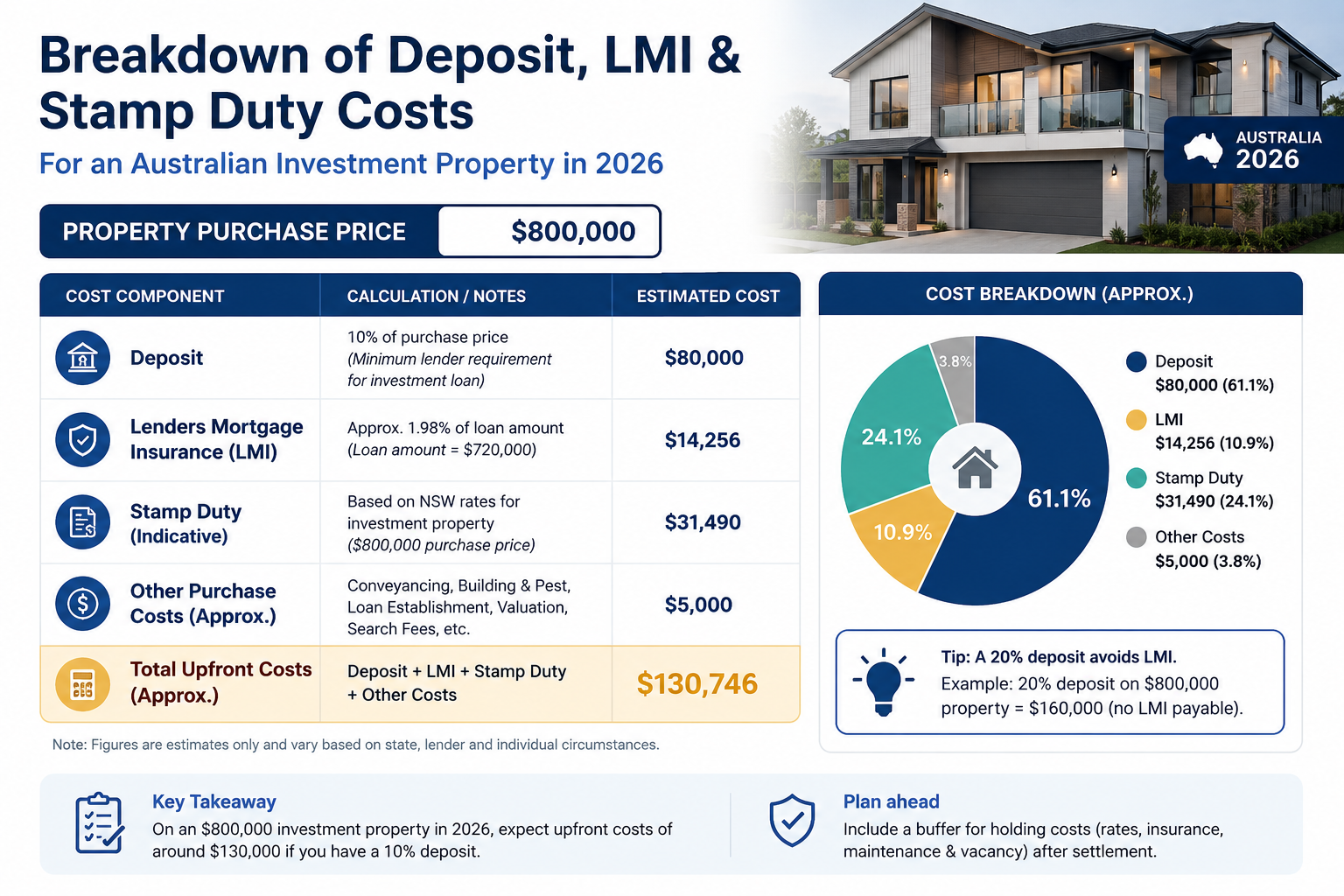
This is where most first-time investors trip up. Here’s what actually goes into that first purchase:
| Cost Component | Typical Range | Notes |
|---|---|---|
| Deposit | 10–20% of purchase price | 20% avoids Lenders Mortgage Insurance (LMI) |
| Lenders Mortgage Insurance (LMI) | Required if deposit is under 20% | Can run from a few thousand dollars into the tens of thousands, depending on the loan size |
| Stamp duty | Varies by state and property value | Investment properties generally miss out on first-home concessions |
| Legal / conveyancing | $1,500–$3,000 | Building and pest inspections usually cost extra |
| Loan establishment & valuation fees | $300–$1,000 | Varies by lender |
On a property near today’s national median of roughly $928,000, a 20% deposit works out to about $185,000 which is exactly why a lot of first-time investors either start below the median, tap into equity from their own home, or look regionally or interstate rather than waiting years to save a six-figure deposit. None of that is a shortcut, by the way they’re all legitimate ways to get your first deal moving without sitting on the sidelines for a decade.
Lenders use your income, existing debts (HECS/HELP included), living expenses, and a mandatory interest-rate buffer usually about 3 percentage points above your actual rate to determine whether you could still service the loan if rates rose. That’s why getting a proper borrowing capacity assessment should be your first move, not something you leave until you’ve already found “the one.”
Step 3: Pick Your Strategy Before You Pick a Suburb
Broadly, first-time investors in Australia land on one of three approaches:
Capital growth focus: going after suburbs and property types with a strong long-term track record for price growth, usually inner and middle-ring capital city spots. Lower yield generally, higher entry price, but historically the stronger long-term wealth builder.
Rental yield focus: chasing higher weekly rent relative to the purchase price, often in regional centres or outer-metro growth corridors. Better cash flow in the short term, but usually slower capital growth.
Balanced strategy: a property with decent yield and decent growth fundamentals. Harder to find, but often the safer starting point if you can’t comfortably wear a big negative cash flow gap each month.
There’s no “best” strategy in isolation only what actually suits your income, your appetite for risk, and how long you’re planning to hold. You should be wary of anyone (including social media ‘gurus’) who claims a single strategy is universally correct. The right one for you is a personal finance question, not a blanket rule.
Step 4: Secure Pre-Approval Before You Start Looking
A pre-approval reveals three things a rough online calculator never will: borrowable amount, actual rate, and credit-file red flags. Go house-hunting with a real number, not an estimate, and you’ll sidestep the classic trap of falling for something you simply can’t finance.

Step 5: Let the Data Do the Talking
Before you shortlist a suburb, have a proper look at:
- Vacancy rate: a tight vacancy rate (well under 2%) tells you there’s genuine rental demand, not just an agent’s optimistic sales pitch.
- Rental yield against the area’s growth history: are you looking at a yield play, a growth play, or neither?
- Infrastructure and jobs pipeline: new transport links, hospitals, or major employers moving in are leading indicators, not lagging ones.
- Supply pipeline: how much new stock (apartments especially) is approved or being built nearby? Too much supply drags down both rent and growth.
- Days on market and auction clearance rates: a live read on buyer competition in that specific pocket, not just the city-wide average.
This is also where a Qualified Property Investment Adviser (QPIA) genuinely earns their fee their job is to stress-test a property against your actual financial strategy using data like this, rather than pointing you toward whatever’s on their books. Worth asking any advisor, buyer’s agent or “property mentor” you speak to whether they actually hold this qualification the industry isn’t tightly regulated, and unqualified “advice” is more common than most people realise.
Step 6: Buy, Settle, and Set Yourself a Review Date
Your first purchase isn’t the finish line it’s the first entry in what will hopefully be a growing portfolio. Once you’ve settled:
- Set a 12-month strategy review has the property actually performed the way it was modelled? Has your borrowing capacity moved?
- Keep an eye on equity growth, not just the rent coming in equity is usually what funds your next purchase.
- Revisit your loan structure every so often refinancing or restructuring can shift your serviceability for a second property more than people expect.
Mistakes Worth Knowing Before You Buy
- Buying with your heart, not your head picking a place you’d want to live in yourself, rather than one the numbers actually support.
- Skipping pre-approval and getting attached to something you can’t finance.
- Ignoring your cash flow buffer not planning for a month of vacancy or another rate rise.
- Not digging into the suburb properly taking one agent’s word for it instead of checking independent vacancy, yield and supply data.
- No plan for what happens next treating the first purchase as “set and forget” instead of step one of an ongoing strategy.
Frequently Asked Questions
How much money do I need to start investing in property in Australia? Most lenders want a 10–20% deposit plus purchase costs (stamp duty, legal fees, loan fees). On a property near today’s national median of roughly $928,000, a 20% deposit sits around $185,000 though a smaller deposit with LMI, using equity from an existing home, or buying below the median can all bring that entry point down.
Is it better to invest in property or pay off my own home first? Honestly, it depends on your equity position, income and goals there’s no one-size-fits-all answer. Plenty of investors use equity in their own home as the deposit for their first investment property rather than waiting to pay it off completely, but it’s worth modelling against your own numbers rather than assuming either way.
What’s the minimum income needed to get an investment loan in Australia? There isn’t a fixed minimum lenders work out your borrowing capacity based on income, existing debt (HECS/HELP included), living expenses and dependants, then apply a serviceability buffer on top. The only reliable way to know your number is a proper assessment from a broker or lender.
Should I buy an established property or off-the-plan for my first investment? Both come with trade-offs established property gives you a known rental and price history with lower settlement risk, while off-the-plan can offer stamp duty concessions in some states and stronger depreciation benefits, but carries settlement timing and valuation risk. This one deserves its own proper comparison rather than a rule of thumb keep an eye out for our upcoming guide on off-the-plan vs established property.
Do I need a property investment advisor to buy my first investment property? It’s not a legal requirement, but a Qualified Property Investment Adviser (QPIA) can stress-test a property against your actual financial strategy and current market data, rather than a generic template. That’s particularly handy on a first purchase, where mistakes are expensive to unwind.
Where to Go From Here
Focus less on finding the perfect property and more on the right order: strategy first, finance second, suburb research third. If you’d rather not figure all this out solo, that’s exactly what Equimax’s QPIA-led, data-driven approach is built for book a personalised strategy session and we’ll work through your borrowing position, strategy fit and shortlist together, rather than you starting from a blank page.
Explore more: I’m a First-Time Investor | Our Process | About Us | Meet Our QPIAs | Client Case Studies
Sources
- Reserve Bank of Australia= Cash Rate Target & August 2026 Monetary Policy Decision (rba.gov.au)
- Cotality (formerly CoreLogic)= Home Value Index, August 2026
- ASIC MoneySmart= Investing in Property moneysmart.gov.au
- Australian Taxation Office= Rental Properties Guide ato.gov.au
