

Rentvesting means renting the home you want to live in while buying an investment property somewhere you can actually afford. You keep your lifestyle (the inner-city apartment, the beachside suburb, the short commute) and build equity in a market that’s realistic on your budget instead of waiting years to save enough for the postcode you’d love to live in.
It’s not a loophole and it’s not new. It’s just become a lot more common because the gap between “where young professionals want to live” and “where they can afford to buy” has widened so much that renting one and investing in the other is now the more rational move for a lot of people.
Quick Answer: Does Rentvesting Actually Work?
For the right person, yes. Rentvesting tends to work well when:
- You don’t feel emotionally tied to owning the home you currently live in.
- Your preferred suburb has weak rental yield relative to its price (which usually means it’s expensive to buy into but cheap-ish to rent)
- You can find a genuinely investment-grade property elsewhere with better yield or growth prospects
- You’re comfortable managing two sets of costs: rent on one side, mortgage and holding costs on the other
It tends to work poorly when you’re chasing the First Home Guarantee or a state First Home Owner Grant (most require you to live in the property), or when your budget is so tight that a vacancy period or a rate rise on the investment loan would genuinely hurt.
Why Rentvesting Has Taken Off in Australia
A few things have lined up to make this strategy mainstream rather than niche:
- Around 31% of Australian households rent, according to ABS Census data, so renting long-term is already a normal, unremarkable choice for a huge slice of the population, not a stopgap.
- Sydney and Melbourne median house prices sit well above $1 million, while the national median dwelling value is closer to $928,000 (Cotality, August 2026), and plenty of regional and outer-metro markets sit well under that.
- According to Westpac’s Home Ownership Report, 54% of first home buyers say they’re now considering rentvesting as a way into the market, up from the year before, and that number climbs to roughly 61% in NSW specifically, where the gap between lifestyle and affordability is widest.
- ATO taxation statistics put the number of individual property investors in Australia at roughly 2.2 to 2.3 million people, a reminder that “owning an investment property while renting yourself” is a well-worn path, not an experimental one.
Here’s a real illustration of the gap driving this: in inner Sydney, a suburb like Marrickville can carry a typical house price north of $2.3 million on a gross rental yield of around 2.4%. That’s an expensive place to buy and a comparatively affordable place to rent. Meanwhile, a property in the high $400,000s in a growth-corridor regional centre can return a gross yield closer to 4.5–5%. Rentvesting is the strategy that lets you live in the first suburb and invest in the second.
How Rentvesting Actually Works, Step by Step
Step 1: Work Out Your Numbers Honestly
Before anything else, map out what you can genuinely afford across two fronts: what you’ll pay in rent each month, and what deposit and borrowing capacity you have for an investment loan. These need to work together, not against each other. If your rent is already eating most of your income, rentvesting isn’t going to magically create room in your budget.
Step 2: Choose Your Investment Location on Data, Not Instinct
This is the step people get wrong most often. The whole point of rentvesting is that you’re not restricted to buying where you live, so use that freedom properly. Look at:
- Rental yield relative to purchase price
- Vacancy rates (tight vacancy signals real tenant demand)
- Vacancy rate and yield trends over the last 12 to 24 months, not just a snapshot
- Infrastructure spend and population growth in the area
Step 3: Get Finance Sorted for an Investment Loan, Not an Owner-Occupier Loan
Investment loans are assessed differently to owner-occupier loans. Lenders typically only count a portion of expected rental income (commonly up to around 80%) toward your serviceability, and investment loan rates can run slightly higher than owner-occupier rates. Get a proper assessment before you shortlist properties, not after.
Step 4: Set Up Your Property Management and Tax Structure Early
Because you won’t be living in the property, a good property manager matters more here than it might for a home you can pop past yourself. It’s also worth speaking to an accountant about how negative gearing, depreciation and rental deductions apply to your situation before settlement, not at tax time.
Step 5: Keep Renting Where You Want to Live
The lifestyle part of rentvesting is the whole point, so this step is easy. Just keep in mind that money spent on rent isn’t building your own equity, which is exactly why the investment side of the equation needs to be pulling its weight.
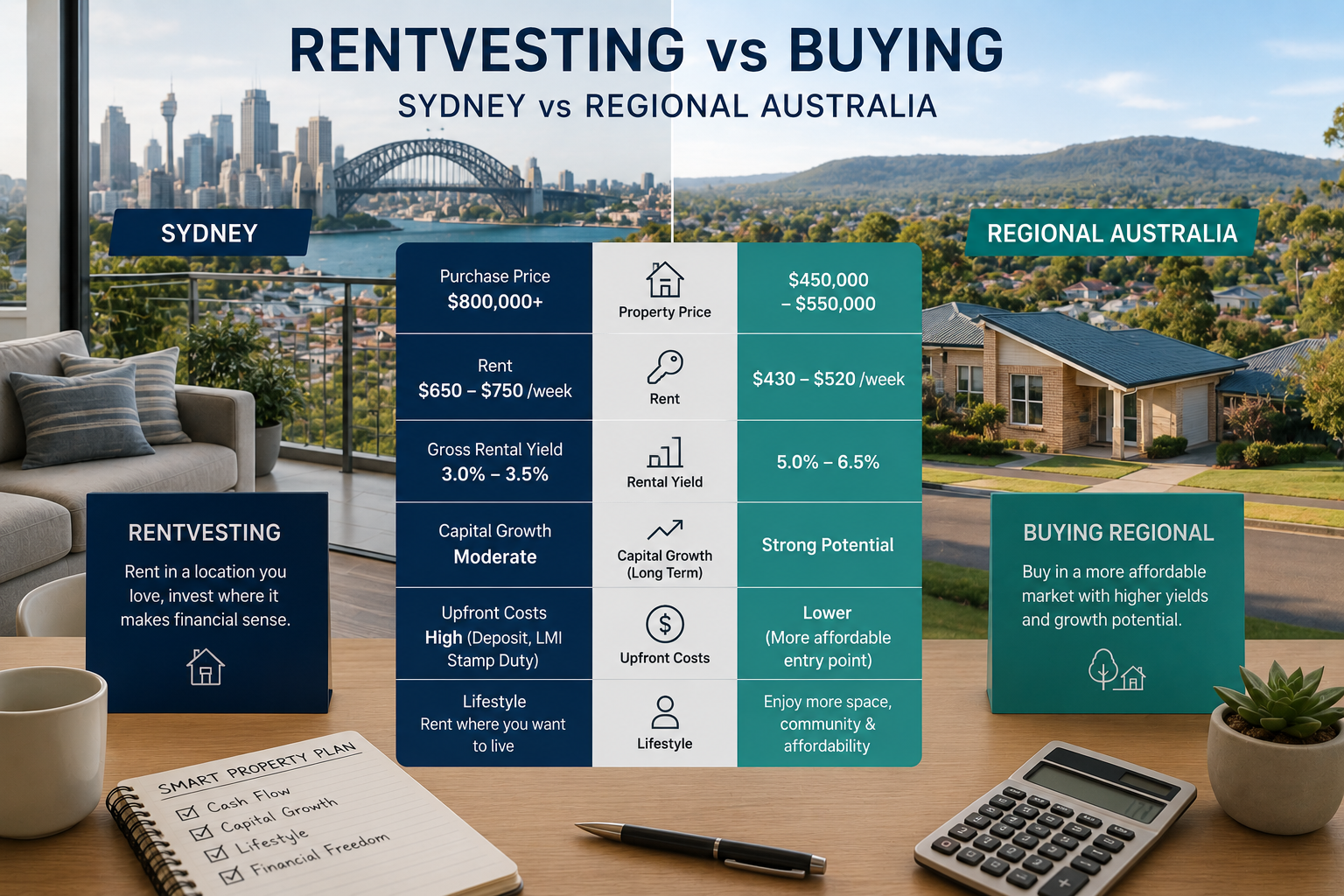
A Worked Example: The Numbers Side by Side
| Buying Where You Want to Live (Inner Sydney example) | Rentvesting (Rent Inner Sydney, Buy Regional) | |
|---|---|---|
| Purchase price | ~$2,300,000+ | ~$470,000–$550,000 |
| Approx. deposit needed (20%) | ~$460,000+ | ~$95,000–$110,000 |
| Gross rental yield | ~2.4% | ~4.5–5% |
| Where you actually live | The property you bought | A rental in the suburb you love |
| Monthly cash flow pressure | High mortgage on a low-yield asset | Rent + investment loan, offset partly by rental income |
Figures are illustrative, based on current Sydney and regional market data, and will vary by suburb, loan structure and lender. Always model your own numbers before deciding.
The gap here is the entire argument for rentvesting: it can take a fraction of the deposit to get into the market, and the asset you’re buying is working harder on a rental yield basis than the one you’d otherwise be stretching to afford.
Rentvesting: Pros and Cons
| Pros | Cons |
|---|---|
| Enter the market sooner with a smaller deposit | You’re paying rent on one property and a mortgage on another |
| Keep living in your preferred suburb or lifestyle location | Miss out on most First Home Guarantee and First Home Owner Grant eligibility |
| Choose an investment property based on yield or growth data, not lifestyle preference | No capital gains tax main residence exemption on the investment property |
| Can start building equity years sooner than “save until you can afford to buy where you live” | Managing a tenant and property remotely if you invest outside your own city |
| Rental income can offset some holding costs | Cash flow is tighter if the property sits vacant or rates rise |
Who Rentvesting Actually Suits
Rentvesting tends to be a strong fit for:
- Young professionals in high-cost cities who value living close to work, friends or lifestyle amenities more than owning bricks and mortar in that exact location
- People with a stable income and a genuine buffer for unexpected costs (a month of vacancy, a rate rise, an unplanned repair)
- Anyone prioritising getting into the market sooner over waiting to save a deposit for their dream suburb
It’s a weaker fit if you’re relying on a First Home Guarantee, a state grant, or a stamp duty concession that requires you to live in the property, or if your budget genuinely can’t absorb a vacancy period without real financial stress.
Tax and Legal Things Worth Knowing
A few points worth raising with your accountant before you commit, not after:
- Negative gearing still applies to a rentvested property the same way it would for any investment property, meaning holding losses may be deductible against your income.
- You lose the main residence CGT exemption on the investment property, since you don’t live in it. Capital gains tax will generally apply when you eventually sell.
- First Home Guarantee and most state grants require owner-occupation, so rentvesting usually means forgoing them on your first purchase.
- Rental income is taxable, and needs to be declared, same as any other investment property.
None of this makes rentvesting a bad idea. It just means the tax and grant trade-offs need to be weighed against the earlier market entry and lifestyle benefit, ideally with proper advice rather than a guess.
Common Rentvesting Mistakes
- Buying an investment property purely because it’s cheap, rather than because the yield and growth fundamentals actually stack up
- Underestimating total holding costs, including property management fees, insurance, maintenance and potential vacancy
- Skipping a proper loan structure conversation, which can limit your ability to buy a second property down the track
- Treating it as a short-term trick rather than a genuine long-term strategy with its own tax and portfolio implications
Frequently Asked Questions
- Is rentvesting a good strategy for first home buyers in Australia? It can be, particularly if you’re priced out of your preferred suburb and don’t mind giving up First Home Guarantee or grant eligibility in exchange for entering the market sooner with a smaller deposit. It suits people prioritising market entry and lifestyle over immediate home ownership in one specific location.
- Do I lose the First Home Owner Grant if I rentvest? In most states, yes. First Home Owner Grants and the First Home Guarantee scheme generally require you to live in the property as your principal place of residence, which rules them out for a rentvested purchase. It’s worth checking your specific state’s current rules before deciding.
- Can I claim negative gearing on a rentvested property? Yes. A rentvested property is treated as an investment property for tax purposes, so the usual negative gearing and depreciation rules apply the same as they would for any investment property, regardless of where you personally live.
- Is it cheaper to rentvest than to buy where I live? Often, yes, at least in terms of the deposit and ongoing repayments required. Whether it’s actually financially better depends on the yield and growth performance of the investment property you buy, compared with the capital growth you’d have captured by buying in your preferred suburb outright. It genuinely varies case by case.
- What’s the difference between rentvesting and just renting? Renting alone means you’re not building equity anywhere. Rentvesting means you’re renting for lifestyle while simultaneously buying and holding an investment property elsewhere, so your money is working toward ownership even though you’re not living in the property you own.
Where to Go From Here
Rentvesting isn’t about finding a shortcut. It’s about separating two decisions that don’t need to be tied together: where you live, and where you invest. Get the investment side wrong and the lifestyle side stops making financial sense pretty quickly, which is exactly why the property you buy needs to be chosen on data and strategy, not convenience.
If you want a second opinion on whether rentvesting actually stacks up for your situation, book a strategy session with our QPIA-led team and we’ll run the numbers against your real income, deposit and goals rather than a generic example.
Explore more: I’m a Young Professional | I’m a First-Time Investor | Our Process | Client Case Studies
Sources
- Australian Bureau of Statistics, Census of Population and Housing (renting households)
- Cotality (formerly CoreLogic), Home Value Index, August 2026
- Westpac, Home Ownership Report
- Australian Taxation Office, Taxation Statistics (individual property investors)
- ASIC MoneySmart, Investment Property and Rentvesting Guidance (moneysmart.gov.au)
